At the core of Mr. Museveni’s National Plan is an ambitious dream of transforming Uganda society. Transforming to what? Supposedly it is tripling the per capita income (GDP/PPP?) to $900 by 2015.
Nothing is wrong with that, except the archaic top-down process of coming out with the plan. We cannot even guess the elements that were taken into considerations. Since you have not consulted widely you miss out important elements—besides the effects of the unknown Heisenberg uncertainty principle in play—and rendering the outcomes unpredictable if not rejected. The whole thing seems Newtonian linear thinking: Input these and you get these formulated results.
As I stated before, others have tried along the same lines. Believe it or not, Museveni himself has tried various schemes, which were effectively national plans. It is telling that none of them has worked beyond the catchy initial grandiose pronouncements. In a photo op the man was seen carrying AGOA shirts for exports to the US. If anybody has seen Uganda shirts in US stores, shout! Did I hear somebody just picked up a Kenyan pair of trousers from a US department store?!
Humans are complex, and Ugandans are no exception—even more so if you consider regional differences and aspirations. In addition, there is the mix of the endemic cultural confusion in the sense of self: What is the essence, if any, of being a Ugandan? So, without being sympathetic to complexities, any policy is dead ab initio.
Material well-being is a good thing. But focusing only on increasing ability to consume is really not transforming society's sustainably. It may end up creating a nation of desperate automatons, full of anger, lust, resentment, fear and depression with no sense of honor and community. And you heven't seen nothing yet of the lethal alienation of blighted forests of slums.
The universal traditional Uganda begins in the village. There is where a sense of honor and community can begin to be instilled and nurtured to translate into the whole country of Uganda—a bottom-up strategy. Anybody who can conjure up ideas about strengthening the spiritual (not necessarily religious) and material well-being of the village will transform Uganda for the better. This would be in accord with scientific evolutionary evidence of how man has managed to survive for millennia in the face of all manners of odds. If the village unit is strong and vibrant, the nation will be strong and vibrant. Chances are families will also be strong—raising strong children. It is so simple, it hurts!
Thursday, April 29, 2010


Monday, April 26, 2010
Way to Go, Otunnu!
The last few weeks Mr. Otunnu has ported himself very favorably. That is how some of us wanted to see him put his considerable gifts and opportunities to good use.
The call to investigate the Luweero war sent a general into a tailspin of mental masturbation. Fuming, with sweats oozing from his armpits, the general warned Otunnu to cease and desist. Mr. Otunnu would have none of it.
Other than the bizarrely contrarian ex-FDC girl, most Ugandans would want the air cleared on who did what in Luweero and the post-Luweero taming of the North.
Before the embers died, another lady from West Nile felt that Otunnu has amnesia about what his kin did in West Nile on the heels of Idi Amin’s hasty exit. She, however, neglected to mention the nine years of horror inflicted on Uganda by her fellow West Nilers. That too need clarification since doubts have been peddled on what really happened.
While the President was concluding his early election campaign tour, dubbed as spreading the word on his Get-Rich something, Otunnu lobbed another grenade: Museveni was in cahoots with the LRA strongman, the enigmatic Joseph Kony, to destabilize the North. What of the funds that the president frequently sent to the bush rat? Mr. Museveni saw stars, and ordered police investigations into the utterances on MP Ogong’s radio station. The ambassador refused to oblige and challenged the constitutionality and interpretation of the law. Now, he walks out of that dump to have a breather— police injunction or not. That is the man!
Dark days are here, and they open up vistas of opportunities. Those with intestinal fortitude will become heroes and save us from ourselves.
Not bad. Not bad, Mr. Otunnu. Way to go!
The call to investigate the Luweero war sent a general into a tailspin of mental masturbation. Fuming, with sweats oozing from his armpits, the general warned Otunnu to cease and desist. Mr. Otunnu would have none of it.
Other than the bizarrely contrarian ex-FDC girl, most Ugandans would want the air cleared on who did what in Luweero and the post-Luweero taming of the North.
Before the embers died, another lady from West Nile felt that Otunnu has amnesia about what his kin did in West Nile on the heels of Idi Amin’s hasty exit. She, however, neglected to mention the nine years of horror inflicted on Uganda by her fellow West Nilers. That too need clarification since doubts have been peddled on what really happened.
While the President was concluding his early election campaign tour, dubbed as spreading the word on his Get-Rich something, Otunnu lobbed another grenade: Museveni was in cahoots with the LRA strongman, the enigmatic Joseph Kony, to destabilize the North. What of the funds that the president frequently sent to the bush rat? Mr. Museveni saw stars, and ordered police investigations into the utterances on MP Ogong’s radio station. The ambassador refused to oblige and challenged the constitutionality and interpretation of the law. Now, he walks out of that dump to have a breather— police injunction or not. That is the man!
Dark days are here, and they open up vistas of opportunities. Those with intestinal fortitude will become heroes and save us from ourselves.
Not bad. Not bad, Mr. Otunnu. Way to go!
Saturday, April 24, 2010
Fire & Brimstone v Diplomacy & Discussion
"How long before Mugisha Muntu returns to NRM?," Gawaya Tegulle asks rhetorically. He answers himself: Soon. Why? Mr. Muntu handles situations with “diplomacy and discussion,” and implicitly, since birds of the same feathers flock together, he would therefore be joining the paragon of said “diplomacy and discussion,” the NRM, a.k.a. Museveni, with whom he did not burn bridges.
I have nothing against Mugisha Muntu. And I have said so in "Who is Mugisha Muntu?" at http://odiyatalks.9hz.com/ He is a good man. If he believed that, by “diplomacy and discussion” he would have brought the NRM into the 21st century governance, why did he leave in the first instance?
Mr. Tegulle goes on in some strange and twisted logic: Mugisha Muntu’s father was a good friend of the late Obote. His son chose undiplomatic and [undiscussion] mode of behavior to unseat his father’s friend. Duh! In the process he probably killed a few people. Wasn’t he the “bandit” who was treated at Mulago Hospital, under the noses of the Obote government?
If this guy is not a sly cat, then I would suspect that the locus of Mr. Muntu’s personality, his modus vivendi, is about fair play, which extends to good governance with all its enlightened accouterments. From what we know by experience, would the NRM then be his natural affinity? Tegulle thinks so, and gives us a glimpse of his politics and intentions.
Gawaya Tegulle is an honorable man. His website is full of interesting insights. In this particular article, however, he has a cocky disdain for Dr. Besigye’s supporters who are caught up in his "lowbrow" tack of “fire and brimstone.” The fact that they might have rationally concluded that Museveni’s modus operandi is “my way or the high road” is just hooey.
Let us be clear: Mr. Tegulle may be culturally amenable to tail-between-the-legs disposition. But he should also know that those who face reality head on know that one can soft-peddle with Museveni until the cows come home to no avail. His language of “diplomacy and discussion” is: entreat me and brown nose and we can talk on my terms—heads, I win; tails, you lose. The man only understands the projections of strength. Kagame and his boys showed him in Kisangani. If it weren’t for Dr. Besigye’s “fire and brimstone,” the political space would have been more restricted than it currently is. Black Mambas would have visited some people by now.
I have nothing against Mugisha Muntu. And I have said so in "Who is Mugisha Muntu?" at http://odiyatalks.9hz.com/ He is a good man. If he believed that, by “diplomacy and discussion” he would have brought the NRM into the 21st century governance, why did he leave in the first instance?
Mr. Tegulle goes on in some strange and twisted logic: Mugisha Muntu’s father was a good friend of the late Obote. His son chose undiplomatic and [undiscussion] mode of behavior to unseat his father’s friend. Duh! In the process he probably killed a few people. Wasn’t he the “bandit” who was treated at Mulago Hospital, under the noses of the Obote government?
If this guy is not a sly cat, then I would suspect that the locus of Mr. Muntu’s personality, his modus vivendi, is about fair play, which extends to good governance with all its enlightened accouterments. From what we know by experience, would the NRM then be his natural affinity? Tegulle thinks so, and gives us a glimpse of his politics and intentions.
Gawaya Tegulle is an honorable man. His website is full of interesting insights. In this particular article, however, he has a cocky disdain for Dr. Besigye’s supporters who are caught up in his "lowbrow" tack of “fire and brimstone.” The fact that they might have rationally concluded that Museveni’s modus operandi is “my way or the high road” is just hooey.
Let us be clear: Mr. Tegulle may be culturally amenable to tail-between-the-legs disposition. But he should also know that those who face reality head on know that one can soft-peddle with Museveni until the cows come home to no avail. His language of “diplomacy and discussion” is: entreat me and brown nose and we can talk on my terms—heads, I win; tails, you lose. The man only understands the projections of strength. Kagame and his boys showed him in Kisangani. If it weren’t for Dr. Besigye’s “fire and brimstone,” the political space would have been more restricted than it currently is. Black Mambas would have visited some people by now.
Thursday, April 22, 2010
What Goes Up Must Come Down
There comes a time when we reach peak performance, abundance or incomparable power. We are at the top of our game however mundane or lowbrow. If we are lucky, we recognize this zenith, act skillfully and enjoy and extend this period. Only for a time, however. Even a snake shades its old skin. Sooner than later, decline sets in, and we must let go, handling the downward slope with equanimity for the benefits of all concerned, or be forced to let go.
When the sun reaches the center, it begins to set. When the moon becomes full, it begins to wane. (Karcher, 2009). In arrogance and/or delusion, we often fail to read or ignore the natural flow. The drunken old man goes bar hopping. What a pitiful sight! Once we brought Fundamental Change and demolished the old. Now, we say: No Change, We are It! What about that!
Mr. Museveni peaked ten years ago. Now he is the drunken old man trying to carouse with the youth of ideas. He is the old hunter insisting that he still has it. Put him under stress, and you will know what he is made of. He will lash out, but the natural forces will prevail.
Wisdom should have informed him to consolidate the rule of law, good intentions and fairness that would have been equally beneficial to him as he staggers to his grave. Instead of accepting natural change, he is spooked and grips tightly. The consequence is a country “—full of distrust, intrigue, hidden motives and general air of darkness.” (Wu Wei, 95). We are back to where we came from: Free speech is muzzled, presidency for life, rule by the gun, and sections of society are hurt and are angered.
Give it days, months or a few more years, it will all unravel. What concerned Ugandans need to be thinking is how to repair post-Museveni era. And Einstein would tell us: Insanity is doing the same thing over and over again and expecting different results.
When the sun reaches the center, it begins to set. When the moon becomes full, it begins to wane. (Karcher, 2009). In arrogance and/or delusion, we often fail to read or ignore the natural flow. The drunken old man goes bar hopping. What a pitiful sight! Once we brought Fundamental Change and demolished the old. Now, we say: No Change, We are It! What about that!
Mr. Museveni peaked ten years ago. Now he is the drunken old man trying to carouse with the youth of ideas. He is the old hunter insisting that he still has it. Put him under stress, and you will know what he is made of. He will lash out, but the natural forces will prevail.
Wisdom should have informed him to consolidate the rule of law, good intentions and fairness that would have been equally beneficial to him as he staggers to his grave. Instead of accepting natural change, he is spooked and grips tightly. The consequence is a country “—full of distrust, intrigue, hidden motives and general air of darkness.” (Wu Wei, 95). We are back to where we came from: Free speech is muzzled, presidency for life, rule by the gun, and sections of society are hurt and are angered.
Give it days, months or a few more years, it will all unravel. What concerned Ugandans need to be thinking is how to repair post-Museveni era. And Einstein would tell us: Insanity is doing the same thing over and over again and expecting different results.
Wednesday, April 21, 2010
Whose National Plan Is It Anyway?
Mr. Museveni unveiled his version of a Five-Year National Plan. What does that mean? He finally admitted that the wild-wild-west IMF/World Bank imposed prescription wasn’t delivering. He might have realized that, despite claims to rosy growth rates, many of the population of Uganda have been left in the dust and the infrastructures continue to go to the dogs.
“Adam Smith’s idea that self-seeking behavior of individuals would add up to the general welfare ----” has not worked. (Ehrenreich, 2009).
This is not the first Uganda plan. Obote I had his Common Man’s Charter and Move-to-the-Left, which Museveni now despises even when he might have welcomed it in his UPC youth-winger days. The swaggering early NRM had its Ten-Point Program, which has long been shelved.
So, today we have another plan which seems proprietary, designed more to score points for the coming elections. Mr. Big Man, the All-Wise Visionary One will just shove it down our throats. It will go down the way of the dodo, not unlike other similarly constructed prior plans.
The concept of a national plan sounds sexy, but the process of coming up with a plan is also a plan itself. There is a need for wide and inclusive involvement to garner emotional buy-ins: Has the question of environmental sustainability been considered with inputs from related experts and concerned civil society? What about the general national health of the population? Was regional equity factored into the equation? What about the messy urbanization with filthy slums?
There are numerous examples of planning processes on the Internet. Portland, a mid-sized US city is undergoing a 25-year plan exercise. Various local entities have been co-opted as Plan Partners. Residents participate through neighborhood meetings and surveys. The city’s last plan cycle produced a light-rail system that other cities are emulating, neighborhood associations, a quasi-government development commission, etc. Check it out at: http://www.pdxplan.com/ or
http://www.portlandonline.com/portlandplan/index.cfm?c=47906

“Adam Smith’s idea that self-seeking behavior of individuals would add up to the general welfare ----” has not worked. (Ehrenreich, 2009).
This is not the first Uganda plan. Obote I had his Common Man’s Charter and Move-to-the-Left, which Museveni now despises even when he might have welcomed it in his UPC youth-winger days. The swaggering early NRM had its Ten-Point Program, which has long been shelved.
So, today we have another plan which seems proprietary, designed more to score points for the coming elections. Mr. Big Man, the All-Wise Visionary One will just shove it down our throats. It will go down the way of the dodo, not unlike other similarly constructed prior plans.
The concept of a national plan sounds sexy, but the process of coming up with a plan is also a plan itself. There is a need for wide and inclusive involvement to garner emotional buy-ins: Has the question of environmental sustainability been considered with inputs from related experts and concerned civil society? What about the general national health of the population? Was regional equity factored into the equation? What about the messy urbanization with filthy slums?
There are numerous examples of planning processes on the Internet. Portland, a mid-sized US city is undergoing a 25-year plan exercise. Various local entities have been co-opted as Plan Partners. Residents participate through neighborhood meetings and surveys. The city’s last plan cycle produced a light-rail system that other cities are emulating, neighborhood associations, a quasi-government development commission, etc. Check it out at: http://www.pdxplan.com/ or
http://www.portlandonline.com/portlandplan/index.cfm?c=47906

Monday, April 19, 2010
The Hyenas Are Here
Senegalese Djibril D. Manibety’s portrayal in the Hyenas might as well have dramatized the present Uganda. In the movie a young girl who was violated by a now-local-celebrity comes back, physically broken but a millionairess, to the town of Colobane. The town has lost its former glory and is poverty stricken. The millionairess, who is richer than the World Bank, offers to rehabilitate the town on one condition.
Well, in the present Uganda you can just about buy anybody, village, town or even the country. Take the case of the Dutchman who asked some villagers to adopt his name for the price of pigs. Recently, a deputy speaker asked the Chinese to build for the country a new parliament building. Did she think these Chinese are fools to give anything for free? Then there is the case of MP Ogong: He is the Lango joker who made a show of competing against Museveni for the NRM flag honcho. Recently he had to kneel and beg Museveni not to shut his radio station for hosting Mr. Otunnu, the president’s virulent critic. Were the Ugandan MPs not bought for merely $5,000 to vote overturning a vital clause in the constitution?
If you lived abroad for a while, come home and sample the nature of people. It is assumed that you have money, and people will do anything to gain your favor. Some will narrate how much you loved them before you escaped your own demons. They don’t tell you they love you—probably hedging their bets. Once you seem not to deliver, all bets are off: you will begin to hear vicious rumors. The rumormongers are not at fault since they never said they loved you—you loved them and now you betrayed them!
Beware of the women. They will confess to loving you the first time you meet even before you open your mouth. Horny white guys are especially vulnerable. Our girls meet them on the Internet and lure them to Kampala. Did you hear of the Dutchman who was taken to the village and shown the grave site of his “son?” Apparently after a vacation of sizzling hot sex, he went back home. The lady who gave him a memorable Mandingo good time called to say that she was “pregnant” and would appreciate his financial support. The poor white boy was happy to oblige.
You want to be a king of your clan, don’t you? All you have to do is convince Museveni that your clan will be nothing but NRM territory and, viola; you have a district or a kingdom if you are so inclined. Now, you will be elected area MP for many election cycles to come. If your stars are well aligned, the appointing authority might even make you an assistant minister—or rather state minister. What is the difference? A minister is a minister to the clansmen. You are now a big man among big men. You might even enter the rarefied kitchen cabinet—the gang of untouchables who have the ears of the king of kings, and who might afford to be naughty jerks without consequences. Now, the villagers can dream of development that will be promised over and over at every election cycle. No problem—the masses can live on hope alone. Didn’t the king of kings tell you to stay alive and healthy for oil moneys will soon come gushing in?
The road from Kalingi to Zambala is full of lake-like potholes and is an amalgam of red muddy porridge when it rains. Send a delegation to Rwakitura to tell the president that you will not vote NRM if your important access to civilization is not paved. Suddenly, money will appear out of thin air—thanks to classified military and state-house budgets. And don’t forget the creative accounting that will go into projects up North. You have your shiny Kalingi-Zambala road.
If you are not yet amazed, check out the packs of super hyenas. These are the lots who tear to shreds moneys donated for treatments of Aids, malaria and tuberculosis. When the super hyenas loot and share the CHOGM heist amongst themselves, they dare anyone to question them about the thievery. Some have no qualm about looting workers’ life savings. Worse still, the hapless workers can do nothing about it because they are not organized. Instead they make it hard on us, the wanainchi: we have to grease their scaly palms at licensing offices; we are harassed by policemen unless we give them chai; and security personnel shoot at us for no apparent reason. Name it; we are the butt of every miserable worker’s angst.
Well, in the present Uganda you can just about buy anybody, village, town or even the country. Take the case of the Dutchman who asked some villagers to adopt his name for the price of pigs. Recently, a deputy speaker asked the Chinese to build for the country a new parliament building. Did she think these Chinese are fools to give anything for free? Then there is the case of MP Ogong: He is the Lango joker who made a show of competing against Museveni for the NRM flag honcho. Recently he had to kneel and beg Museveni not to shut his radio station for hosting Mr. Otunnu, the president’s virulent critic. Were the Ugandan MPs not bought for merely $5,000 to vote overturning a vital clause in the constitution?
If you lived abroad for a while, come home and sample the nature of people. It is assumed that you have money, and people will do anything to gain your favor. Some will narrate how much you loved them before you escaped your own demons. They don’t tell you they love you—probably hedging their bets. Once you seem not to deliver, all bets are off: you will begin to hear vicious rumors. The rumormongers are not at fault since they never said they loved you—you loved them and now you betrayed them!
Beware of the women. They will confess to loving you the first time you meet even before you open your mouth. Horny white guys are especially vulnerable. Our girls meet them on the Internet and lure them to Kampala. Did you hear of the Dutchman who was taken to the village and shown the grave site of his “son?” Apparently after a vacation of sizzling hot sex, he went back home. The lady who gave him a memorable Mandingo good time called to say that she was “pregnant” and would appreciate his financial support. The poor white boy was happy to oblige.
You want to be a king of your clan, don’t you? All you have to do is convince Museveni that your clan will be nothing but NRM territory and, viola; you have a district or a kingdom if you are so inclined. Now, you will be elected area MP for many election cycles to come. If your stars are well aligned, the appointing authority might even make you an assistant minister—or rather state minister. What is the difference? A minister is a minister to the clansmen. You are now a big man among big men. You might even enter the rarefied kitchen cabinet—the gang of untouchables who have the ears of the king of kings, and who might afford to be naughty jerks without consequences. Now, the villagers can dream of development that will be promised over and over at every election cycle. No problem—the masses can live on hope alone. Didn’t the king of kings tell you to stay alive and healthy for oil moneys will soon come gushing in?
The road from Kalingi to Zambala is full of lake-like potholes and is an amalgam of red muddy porridge when it rains. Send a delegation to Rwakitura to tell the president that you will not vote NRM if your important access to civilization is not paved. Suddenly, money will appear out of thin air—thanks to classified military and state-house budgets. And don’t forget the creative accounting that will go into projects up North. You have your shiny Kalingi-Zambala road.
If you are not yet amazed, check out the packs of super hyenas. These are the lots who tear to shreds moneys donated for treatments of Aids, malaria and tuberculosis. When the super hyenas loot and share the CHOGM heist amongst themselves, they dare anyone to question them about the thievery. Some have no qualm about looting workers’ life savings. Worse still, the hapless workers can do nothing about it because they are not organized. Instead they make it hard on us, the wanainchi: we have to grease their scaly palms at licensing offices; we are harassed by policemen unless we give them chai; and security personnel shoot at us for no apparent reason. Name it; we are the butt of every miserable worker’s angst.
Friday, April 16, 2010
The Days of the Cauldron is Nigh
In his usual self-adulations, many a time Museveni described the NRM government, a.k.a. Yoweri Kaguta Museveni, as propped by a set of tri-cooking stones—the military being one of them. He has not disappointed himself after twenty four years in power. He wants more even as the food coming out of the pot is stale. Besides, cooking stones can often be unstable. What if one of them rolls? Guess what?
Not to worry. The nature of the Universe is change. After Winter comes Spring. After the Dry season, comes the Rainy season. After the revolution expels the old, a new order follows which must be tied to heaven and earth, must be solid and stable, must serve all people, and must be guided by the enlightened. If not, then the primitive cooking stones must be replaced by the ding, the ancient Chinese version of the cooking cauldron.
In ancient Chinese civilization the ding was a cast bronze cauldron with three legs and high loop handles cast into a rim. It stood directly over fire for cooking, and its handle allowed it to be lifted to and from the fire.
The ding symbolized the ideal person (akin to Confucius’ superior person), tempered by fire, standing solid and stable with food (his spirit) inside transformed for all to share in his noble courage and enlightened leadership. In today’s Uganda who more exemplifies this ideal than Dr. Besigye? He is the Uganda’s cooking ding. He has and continues to endure Museveni’s flames.
(Deng, 2006)
Not to worry. The nature of the Universe is change. After Winter comes Spring. After the Dry season, comes the Rainy season. After the revolution expels the old, a new order follows which must be tied to heaven and earth, must be solid and stable, must serve all people, and must be guided by the enlightened. If not, then the primitive cooking stones must be replaced by the ding, the ancient Chinese version of the cooking cauldron.
In ancient Chinese civilization the ding was a cast bronze cauldron with three legs and high loop handles cast into a rim. It stood directly over fire for cooking, and its handle allowed it to be lifted to and from the fire.
The ding symbolized the ideal person (akin to Confucius’ superior person), tempered by fire, standing solid and stable with food (his spirit) inside transformed for all to share in his noble courage and enlightened leadership. In today’s Uganda who more exemplifies this ideal than Dr. Besigye? He is the Uganda’s cooking ding. He has and continues to endure Museveni’s flames.
(Deng, 2006)
Monday, April 12, 2010
Unity Is Far Beyond the Horizon
It is interesting to see the Arusha East African legislatures taking themselves seriously about the East African Union. Whether they are emotionally rather than intellectually committed to that realisation is another matter. Or are they just going through the motion for the relatively lucrative paychecks? One also wonders whether the citizens of the various nations are as excited about the prospects of a union. What does it mean to them? Is it a life changer they can visualize?
One motivation of an East African government comes partly from a nostalgia of what used to be the East African Community. In its early heydays it was quite elegant, and could have been ahead of the EU. The EAC fell apart—thanks to Idi Amin and the ravenous Kenyatta’s Kenya. Have things changed such that strains and upheavals in one member state would not set the dream structure crumbling?
Another impetus to the East African government is the success of the European Union. This is a false hope, not unlike the fall of the Berlin Wall that initiated democratic movements across the globe but seems to bypass Africa. The EU did not come about out of thin air. The Europeans pulverized one another in primitive orgasmic violence for centuries. Exhaustion and cultural evolutions finally allowed them to see the follies of their ways, hence the trust and unity that spawned the union.
In the East African milieu there is the turn-coat Marxist Museveni who has become a champion of market economy. Market, market, market. All our problems will be solved and we will reach nirvana if only we could have more markets. Forget that trade beyond selling lagalagala (pancakes) can only thrive on trusts. There is no chasm between the Jaluos and Kikuyus of Kenya, and there is no potential powder keg. The Tutsis and Hutus in Rwanda and Burundi are love-struck with one another even if Kagame, the Tutsi dictator is gone. In Uganda Mr. Museveni peddles his get-rich scheme and the water is clear and all will be well even as he guns down his own citizens and is paranoid about the opposition, especially the daring Dr. Besigye.
What we have in East Africa are serious risks, not uncertainty that accompanies any progressive free-enterprise economy. In complex systems, which include the economy, the parts can self-organize randomly into an entity amidst uncertainty—the so-called “invisible hand.” However, there must be a stable global structure and, in the case of nations coming together, that structure comprises common generally accepted standards of behavior. Do these countries slated for the EA union have any common standards they subscribe to? If not, then let us go slow. Jointly building a fast train system traversing the prospective member states could be a good start to fire the imagination of the masses. What about an East African football league championed by the leaders?
One motivation of an East African government comes partly from a nostalgia of what used to be the East African Community. In its early heydays it was quite elegant, and could have been ahead of the EU. The EAC fell apart—thanks to Idi Amin and the ravenous Kenyatta’s Kenya. Have things changed such that strains and upheavals in one member state would not set the dream structure crumbling?
Another impetus to the East African government is the success of the European Union. This is a false hope, not unlike the fall of the Berlin Wall that initiated democratic movements across the globe but seems to bypass Africa. The EU did not come about out of thin air. The Europeans pulverized one another in primitive orgasmic violence for centuries. Exhaustion and cultural evolutions finally allowed them to see the follies of their ways, hence the trust and unity that spawned the union.
In the East African milieu there is the turn-coat Marxist Museveni who has become a champion of market economy. Market, market, market. All our problems will be solved and we will reach nirvana if only we could have more markets. Forget that trade beyond selling lagalagala (pancakes) can only thrive on trusts. There is no chasm between the Jaluos and Kikuyus of Kenya, and there is no potential powder keg. The Tutsis and Hutus in Rwanda and Burundi are love-struck with one another even if Kagame, the Tutsi dictator is gone. In Uganda Mr. Museveni peddles his get-rich scheme and the water is clear and all will be well even as he guns down his own citizens and is paranoid about the opposition, especially the daring Dr. Besigye.
What we have in East Africa are serious risks, not uncertainty that accompanies any progressive free-enterprise economy. In complex systems, which include the economy, the parts can self-organize randomly into an entity amidst uncertainty—the so-called “invisible hand.” However, there must be a stable global structure and, in the case of nations coming together, that structure comprises common generally accepted standards of behavior. Do these countries slated for the EA union have any common standards they subscribe to? If not, then let us go slow. Jointly building a fast train system traversing the prospective member states could be a good start to fire the imagination of the masses. What about an East African football league championed by the leaders?
Friday, April 9, 2010
True to Character
A dog always goes back to its own vomit and, so Museveni characteristically bared his ugly fangs. That he would go native against his perennial nemesis, Dr. Besigye, was expected. But even the teeming millions of peasants wished he had graduated to some semblance of a statesman that would be worthy of a future historical figure of pride. Instead, we are seeing what is turning into a demon before our very eyes. Can we have a genuine civilized debate rather than the banal chicanery and abuse of power?
Pity those who are burdened with investigating the doctor for utterances they know quite well are spins out of context for political machination. He is panicking not unlike when he went physically to orchestrate the doctor’s arrest on his triumphal campaign march on Kampala. Now, instead of explaining the rationale for selling lakes, which his minister has confirmed, he resorts to obscurantism and underhanded tactics—symptoms of moral cowardice and depravity, sold as strength to the gullible.
Let us get back to the dilapidated infrastructures, deplorable health services, the millions who are left in the cold in the NRM “economic boom,” and the rampant corruptions and abuse of power. Who has been there at the helm for all these years and has not figured out how to run the country other than by intrigue and malevolent quest for self-perpetuation? Who, on the other hand, has shown unsurpassed courage in the face of a diabolical, maniacal dictatorship? Who gives a promise of changing the course of Uganda’s history?
This time around it is going to be different. In a rematch of the two titans, the choice is unequivocal. It would have been easier to succumb to exhaustion and despondency after what he has faced, but it is heart-warming to see Dr. Besigye staking his life upon his conviction for a more just Uganda society anchored on policies that would bring up the lot of the many.
Monday, April 5, 2010
Soko's Must-Read Pick
• Begged water does not quench thirst---Probably a Kiganda saying
R Dowden, Africa
• Then most damaging effect of colonialism was psychological: Africans have been so deeply scarred by white imperialism that they had lost their pride, their self-respect.---Until they stoop up, proud of being black and African, they would always be or make themselves victims.
Frantz Fannon in R Dowden, Africa
• In the end, the greatest impact of European imperialism in Africa may have been neither political nor economic. It may have been psychological: the destruction of the African self-belief
RD, Africa
• Some African empires in pre-colonial times had elements of totalitarian dictatorship. In the Zulu empire in Southern Africa, the Ashanti in West Africa and the Buganda Kingdom, the kings were virtual gods. But these empires were the exceptions rather than the rule. Most pre-colonial political systems contained strong democratic elements.
---------Although few African societies were pure democracies, some, like the Igbo of Nigeria, and the Acholi in Uganda, were almost egalitarian, at least among men.
R. Dowden, Africa, Pg. 71
• We imagine corruption to be like a tick on a dog. There are some places in Africa where the tick is bigger than the dog.
John Robertson in RD’s Africa
------------------------------------
Richard Dowden’s Africa is written for his fellow westerners who have little clues about the realities of Africa. Having not travelled far and wide in Africa, many Africans could learn from some pointers and nuggets of insights. Moreover, Chinua Achebe endorsed the book.
Mr. Dowden first came to Africa as a teacher in Buganda. Thereafter, he became a journalist and travelled widely throughout the Black Continent. Here is a sample of some pointers and questions that one might not have thought of or asked:
• Why is Somalia so dysfunctional despite having one language and one Sunni Moslem religion? Even more intriguing, in the milieu of chaos, they can build cellular networks that allow money transfers outside the common western networks many of us are familiar with? Why and how do they do it?
• Who are the Angolans (other than being MPLAs) that Savimbi fought? How were western oil companies able to operate during the Cold War when the MPLA was a communist outfit propped militarily by Cuba?
• What happened to Nkomo and the Ndebele after Mugabe’s Gukurahundi?
• Did you know that Southern Sudan could have become a French territory had the French not blinked at Fashoda?
• Why did Mbeki, a highly educated man, fail and was toppled by a street-smart hoodlum? So much about our preoccupation with mere book education.
• So, you thought Africans, even in the Diaspora, are so distrustful of one another that they are unable to do anything substantial. Find out about a Senegalese group with an amazing world-wide network.
• Did you know that there is an emerging crop of African managers who are as disciplined, ethical and sophisticated as any in New York, London or Tokyo?
Etc, etc, etc.
Friday, April 2, 2010
Who Has Benefited from Debt Forgiveness: Museveni or Ugandans?
In the movie, Bamako, African lawyers and administrators, supported by a western liberal, make the case of the onerous national debts of the least developed countries. A western bank official responds by attacking the mismanagement by these countries’ leaders. Who is right?
When the debt forgiveness was being debated in Washington some US legislators questioned the purchase of a very expensive private jet by Museveni at the same time as Uganda’s debt forgiveness was being debated. Museveni’s supporters, led by the Black Caucaus, faught off any attempt to derail the purchase. Thanks to expensive lobbying with Uganda’s taxpayers’ moneys. Uganda’s debt was forgiven, and American taxpayers footed the bill. It means now Uganda had money available it could use for purposes other than paying the principle and interests.
The motivation behind the debt forgiveness was that these countries could now have resources to improve the quality of life for their people. What has happened in Uganda since then?
First, Mr. Museveni purchased for himself a sleek jet, with operation costs running in the millions as he jets around the world. He has now retired the old one, and upgraded. Questions are abound as to what has been done with money from sale of the old jet.
Next, Museveni boldly defied the so-called development partners who bankroll his national budget to the tune of nearly 50%. He would not limit his military expenditure. He even created himself a well-armed battalion, headed by his son, for his personal protection.
The state house in Kampala was no longer good enough for him. He renovated the colonial government residence in Entebbe to the tune of billions of shillings. This is his new presidential palace.
Now there is talk of building a high-rise tower for himself and his prime minister.
All these expenditures and others would not have been possible without debt forgiveness. At the same time the healthcare system is a figment of what the British left and the Obote I government improved on. The roads improved for CHOGM are again falling apart.
Wednesday, March 31, 2010
Otunnu to Wed!
Soko had the prescient to suggest that, if Otunnu picked a nubile Munyankole girl for a bride, his political fortunes would be greatly enhanced. A Mukiga is not far off! Good luck Mr. Olara Otunnu!
>
>
Tuesday, March 23, 2010
Is Mao a Joker?

Norbert Mao (R) ki Walter Ochora guruku uniform me UPDF
http://newvision.co.ug/news_photos/1247046445mao.jpg
Mao seems to have been stung by being called a joker by Museveni. Talking about a fragile ego: Is he or is he not a joker?
Good judges of characters would say that Mao is full of himself. He takes himself seriously, and thinks he is the best thing for Uganda since the telegenic Princess Bagaya painted a human profile to the blood-soaked macabre nation of the man-eating Idi Amin.
In a discussion group someone once questioned Mao’s wisdom for his one-year stint at Yale when his constituency was experiencing horrendous pain in the LRA war. It was observed that, if Mao were serious about his quest for the presidency, one of his bets would have been to pursue with zeal the cause to end that war, whose origin was justified but had become senseless and directionless. This would have given him the credibility, even in the important South which hitherto had not given a hoot to what happened to the “Anyanyas,” other than that the costs of the war was draining the national coffer, and increasingly the image abroad. Well, he kind of was part of the latest fizzled peace process, but it was symbolically too late to shine the limelight on himself as a man who adroitly forced Museveni to the table.
When the NRM government was toying with turning their concentration camps into towns, Mao was in lockstep support of the notion. That was unacceptable, and Mao was told so in no uncertain terms.
Among other strange behaviors is Mao’s donning of military uniform and participating in Museveni’s pet militia exercise. He lamely has explained that he wanted to understand how Museveni has kept himself in power for this long. Yes, you have to know your opponent to have any chance against him, but this exercise was pure crock tactically. No wonder; Museveni has no respect for him.
Now, he says he is listing Museveni’s weaknesses. Wait a minute: Museveni and others do not publicly announce their listings but spring with attacks that put their opponents in weakened reactive modes.
Oranges and apples are different kinds of fruits. Mao wished Museveni had taken him and other jokers to the Mt. Elgon mudslides a la Clinton-Bush trip to Haiti. What?! And steal the limelight from Museveni? Look; even his joker of a Prime Minister had to hitch a ride in a rickety helicopter with the only photo opportunity prostrated in a hospital bed—an image of weakness.
Let us be brutally frank: Anybody from the North, especially Acoli, who aspires to the presidency now, must be either stupid or blinded by ambition. This does not mean things will not change, but this is a time for a collective self-reassessment, reconstituting, building and consolidating. Would a farmer be harvesting in December when he didn’t plant anything in the rainy season? In 2011 there is no time for jokers like Mao. Even if he has the tongue of lakwal (a bird) and can come up with great plans, so far he has not shown a championship pugilist instinct and the Northern stars are not aligned in an auspicious direction at this time. The main focus should be about getting rid of Museveni, the most dangerous man in the annals of our history.
Sunday, March 21, 2010
The Ghosts of Luweero
In a testosterone-loaded outburst, the handlebar mustachioed Intelligence Chief-cum-General Tinyefuza would “crush” Otunnu for resurrecting the controversial question that dogs memories of the Luweero war: Who [done] it? That is, who murdered civilians in the war theater? Was it Museveni in a tactical stoking of hatred of the government of the day? Was it Obote in retribution for or creating fear against collaborating with the bandits?
If all sides showed humility for the carnage of war in the area and not exploit their versions for political mileage, it would make sense to let by-gone be by-gone. What, however, motivated Otunnu in bringing the issue for finding the truth is the fact that his nemesis, Mheshimiwa Rais Museveni, in his perennial crowing as a victor, constantly blames Obote and his red party for the civilian deaths. UPC is not my favorite party and I am not as impressed as others are about Otunnu, but let us play fair with the truth. It will set us free! Besides, I don’t like the smell of a military man warning someone who could potentially become his boss. (Dream on, Soko—it is free, isn’t it?)
Letting by-gone be by-gone or reconciliation without outing the truths a la Mao is a recipe for future disaster. It is just shoving dirt under the mat. Who knows what kinds of bugs might eventually fester beneath?
Let us clean the house and exorcise the ghosts of Luweero once and for all. While we’re at it, questions also linger in the North about who did what to civilians. The Northern ghosts also need the truth so that they can rest in peace on Lututuro, Got Okaka, Agoro, or in Lapul of the Palaro people
If all sides showed humility for the carnage of war in the area and not exploit their versions for political mileage, it would make sense to let by-gone be by-gone. What, however, motivated Otunnu in bringing the issue for finding the truth is the fact that his nemesis, Mheshimiwa Rais Museveni, in his perennial crowing as a victor, constantly blames Obote and his red party for the civilian deaths. UPC is not my favorite party and I am not as impressed as others are about Otunnu, but let us play fair with the truth. It will set us free! Besides, I don’t like the smell of a military man warning someone who could potentially become his boss. (Dream on, Soko—it is free, isn’t it?)
Letting by-gone be by-gone or reconciliation without outing the truths a la Mao is a recipe for future disaster. It is just shoving dirt under the mat. Who knows what kinds of bugs might eventually fester beneath?
Let us clean the house and exorcise the ghosts of Luweero once and for all. While we’re at it, questions also linger in the North about who did what to civilians. The Northern ghosts also need the truth so that they can rest in peace on Lututuro, Got Okaka, Agoro, or in Lapul of the Palaro people
Friday, March 19, 2010
Everything is Political
The Neanderthals perished because they each lived isolated from one another in the caves of Europe. Their basic stone tools did not improve beyond the rudimentary. When their cousins of the African Homo erectus discovered association with one another, they started carving more complex stone tools due to exchange of ideas. This association imperative developed in the psychic into inheritable instincts and became crucial for the survival of the species. Even to this day groups which have perfected the mechanics of association prosper. These mechanics are often political in nature.
So, in the Uganda milieu, the success of the Baganda, as a group, is unquestionable. The name Uganda comes from Buganda, the land area of the Baganda. The Baganda wear this position with pride and seeming arrogance that can draw fear and envy. Their power of numbers elicits fawning from the politicos. It is, therefore, not surprising that Buganda has, from the inception of the nation called Uganda, been the hotbed of political theatres from where all else emanate. The Northern LRA phenomenon was only a blip (however painful psychologically to the region) in the annals of Uganda history.
This brings us to the burning of the Kasubi tombs, the burial place of the Baganda Kings. This is sacred ground, a symbol of an illustrious past that the parties concerned wish to honor as they forge their future. Who did it, and why? There will be all kinds of conspiracy theories, but we may never find out who did it. The why is obvious: political effect. The perpetrator wanted an outcome.
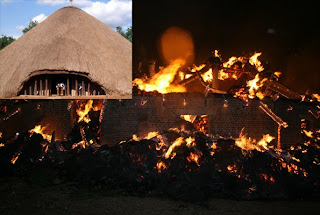
http://www.monitor.co.ug/News/National/-/688334/882308/-/wjqv0n/-/index.html
As the nation gets her bearing and politicians clamor with affected long faces, a Mengo official warned them not to exploit the incident as they were falling all over themselves to shed tears with the Kabaka. But, however one spins it, the very act of the monarchists emotionally gathering at the scene is political. And, like moths attracted to light, you can’t fault politicians to smell opportunities. Had Museveni not gone, it would have been uncharacteristic. He may, however, regret for the rest of his life that he miscalculated and forced his way in, killing three royalists in the process.
Otunnu, God bless him, on the other hand, was pelted with stones, his car smashed, and was humiliatingly forced to speak a language he had no command of. Incidentally, this language demand is one of the unintended consequences which will have its own dark wings. One may surmise that the confrontational encounter confirms that Otunnu’s political instinct and judgment is wanting. His best overture to the Baganda would have been to start with the Baganda establishment officials, who are used to dealing with leeches, hyenas and lions of politics. The aversion he received does not augur well for his strategic aim at mending fences. There will be copycats throughout the Buganda territory.
Overall the holocaust of the tombs portends a “butterfly effect” that may cascade into unpredictable yet deterministic results. It is all political.
So, in the Uganda milieu, the success of the Baganda, as a group, is unquestionable. The name Uganda comes from Buganda, the land area of the Baganda. The Baganda wear this position with pride and seeming arrogance that can draw fear and envy. Their power of numbers elicits fawning from the politicos. It is, therefore, not surprising that Buganda has, from the inception of the nation called Uganda, been the hotbed of political theatres from where all else emanate. The Northern LRA phenomenon was only a blip (however painful psychologically to the region) in the annals of Uganda history.
This brings us to the burning of the Kasubi tombs, the burial place of the Baganda Kings. This is sacred ground, a symbol of an illustrious past that the parties concerned wish to honor as they forge their future. Who did it, and why? There will be all kinds of conspiracy theories, but we may never find out who did it. The why is obvious: political effect. The perpetrator wanted an outcome.

http://www.monitor.co.ug/News/National/-/688334/882308/-/wjqv0n/-/index.html
As the nation gets her bearing and politicians clamor with affected long faces, a Mengo official warned them not to exploit the incident as they were falling all over themselves to shed tears with the Kabaka. But, however one spins it, the very act of the monarchists emotionally gathering at the scene is political. And, like moths attracted to light, you can’t fault politicians to smell opportunities. Had Museveni not gone, it would have been uncharacteristic. He may, however, regret for the rest of his life that he miscalculated and forced his way in, killing three royalists in the process.
Otunnu, God bless him, on the other hand, was pelted with stones, his car smashed, and was humiliatingly forced to speak a language he had no command of. Incidentally, this language demand is one of the unintended consequences which will have its own dark wings. One may surmise that the confrontational encounter confirms that Otunnu’s political instinct and judgment is wanting. His best overture to the Baganda would have been to start with the Baganda establishment officials, who are used to dealing with leeches, hyenas and lions of politics. The aversion he received does not augur well for his strategic aim at mending fences. There will be copycats throughout the Buganda territory.
Overall the holocaust of the tombs portends a “butterfly effect” that may cascade into unpredictable yet deterministic results. It is all political.
Wednesday, March 17, 2010
It Could Get Worse Before It Gets Better
*"The best leader is therefore the enlightened leader. The best ruler does not wield an ax but raises a lantern. Those who try to rule by fire are destroyed by fire. Those who rule by bringing light to others join with ever-increasing radiance.
-
-
“An attack against you is an imbalance in the natural course, and you must apply as much vigor as necessary to restore balance.”
(Ming-Dao, 2006)
*If you are a coward, go back into your mother’s womb.
----Ancient Acoli Warrior
*Rwot, i neka ki nyero (Chief, you kill me with laughter!)
----Acoli aphorism
Things are heating up: The so-called development partners have tossed the gauntlet with a salvo to the EC: you are a spoilsport with the voter registration hanky-panky.
This touched off a raw nerve in the favorite son, the once head boy of the celebrated “new breed” of African leaders. Like a spoilt brat, he hyperventilated and declared or, rather, ordered: stick to developments in areas of your competence without tying them with governance. I know governance. Governance is my expertise.
Excuse me, Monsieur le President, just what is your understanding of good governance? There is more to it than artificial stability, important as it is. If we are to read you from how you have operated so far, we take it that you prefer to be, effectively, an absolute monarch. This is your default predisposition. All the grandiose posturing is just a means to an end: absolute and unadulterated power. This is sooooooo primitive and backward (your own favorite adjectives) by 21st century standard.
If the taxpayers of the development partners were aware of what they were propping, they would agitate to turn off the money faucet. So, beware, Mr. President. The Chinese might even shun you.
What is going on here? The man has been their agent of convenience. He was more ecstatic than the master when a Sudanese pharmaceutical factory was bombed by the Americans. He was rwot-i-neka-ki-nyero(chief, you kill me with laughter: butt-kissing in Acoli). The man was probably the go-between messenger in the process leading to the settlement in the Kaddafi-Lockerbie case when he made frequent trips to Tripoli. No African potentate could be heard louder across the Atlantic than President Yoweri Museveni. In Washington he was the toast of Black Congressional Caucus and white liberal lawmakers. Thanks, in parts, to the charm of the then long-serving ambassador and the well-paid African-American lobyist. These lawmakers were in his corner to approve the bill to forgive Uganda’s debt even as the Uganda president was purchasing for himself a 40 million-dollar jet with all the trimmings. Do the math: American taxpayers, in effect, bought the dictator a jet! Talk about the fleecing of America. Wait until the media hounds get a wind of this.
The question of immediacy for us is: will the sugar daddies, led by Washington, pull the rug if the dude doesn’t shape up? Chances are they won’t, and the man may or may not capitulate by threats alone. He may feel trapped in a corner like wild a dog. What are his options? Will he lash out like a cobra if you mess with its tail? By all indications, deep down, he is coward who could resort to nefarious and underhanded means to silence the opposition. The opposition should brace up for dark days ahead—days when the ancient Acoli warrior’s refrain warned: If you are a coward, go back into your mother’s womb!
As the night darkens before sunrise, the end of an era may be nigh yet so far away. This is the time for skillful actors. Rash, raw ambition only won’t cut it. In the end, the "butterfly effect," in the Chaos Theory may initiate sorting things out.
-
-
“An attack against you is an imbalance in the natural course, and you must apply as much vigor as necessary to restore balance.”
(Ming-Dao, 2006)
*If you are a coward, go back into your mother’s womb.
----Ancient Acoli Warrior
*Rwot, i neka ki nyero (Chief, you kill me with laughter!)
----Acoli aphorism
Things are heating up: The so-called development partners have tossed the gauntlet with a salvo to the EC: you are a spoilsport with the voter registration hanky-panky.
This touched off a raw nerve in the favorite son, the once head boy of the celebrated “new breed” of African leaders. Like a spoilt brat, he hyperventilated and declared or, rather, ordered: stick to developments in areas of your competence without tying them with governance. I know governance. Governance is my expertise.
Excuse me, Monsieur le President, just what is your understanding of good governance? There is more to it than artificial stability, important as it is. If we are to read you from how you have operated so far, we take it that you prefer to be, effectively, an absolute monarch. This is your default predisposition. All the grandiose posturing is just a means to an end: absolute and unadulterated power. This is sooooooo primitive and backward (your own favorite adjectives) by 21st century standard.
If the taxpayers of the development partners were aware of what they were propping, they would agitate to turn off the money faucet. So, beware, Mr. President. The Chinese might even shun you.
What is going on here? The man has been their agent of convenience. He was more ecstatic than the master when a Sudanese pharmaceutical factory was bombed by the Americans. He was rwot-i-neka-ki-nyero(chief, you kill me with laughter: butt-kissing in Acoli). The man was probably the go-between messenger in the process leading to the settlement in the Kaddafi-Lockerbie case when he made frequent trips to Tripoli. No African potentate could be heard louder across the Atlantic than President Yoweri Museveni. In Washington he was the toast of Black Congressional Caucus and white liberal lawmakers. Thanks, in parts, to the charm of the then long-serving ambassador and the well-paid African-American lobyist. These lawmakers were in his corner to approve the bill to forgive Uganda’s debt even as the Uganda president was purchasing for himself a 40 million-dollar jet with all the trimmings. Do the math: American taxpayers, in effect, bought the dictator a jet! Talk about the fleecing of America. Wait until the media hounds get a wind of this.
The question of immediacy for us is: will the sugar daddies, led by Washington, pull the rug if the dude doesn’t shape up? Chances are they won’t, and the man may or may not capitulate by threats alone. He may feel trapped in a corner like wild a dog. What are his options? Will he lash out like a cobra if you mess with its tail? By all indications, deep down, he is coward who could resort to nefarious and underhanded means to silence the opposition. The opposition should brace up for dark days ahead—days when the ancient Acoli warrior’s refrain warned: If you are a coward, go back into your mother’s womb!
As the night darkens before sunrise, the end of an era may be nigh yet so far away. This is the time for skillful actors. Rash, raw ambition only won’t cut it. In the end, the "butterfly effect," in the Chaos Theory may initiate sorting things out.
Wednesday, March 10, 2010
Dr Besigye is the Man


http://en.wikipedia.org/wiki/Kizza_Besigye
http://www.fdcuganda.org/Dr_Besigye.html
http://news.bbc.co.uk/2/hi/africa/1191395.stm
http://observer.ug/index.php?option=com_content&view=article&id=6387:gloves-off-as-dr-besigye-confronts-police-in-hoima&catid=34:news&Itemid=59
http://www.besigye.blogspot.com/
His head spun. His legs quaked as the legendary stout, grotesque-looking Math teacher, Mr. Kiwanuka, glared at him. Forlornly he stood in front of the fearsome panel of the disciplinary committee of teachers. Mr. Kiwanuka asked what the boy would do if he were the dormitory prefect he had spurned and disobeyed. He responded that he would talk with the “culprit” about the issue of contention and try to resolve it before taking matters to the august body! The boy could see the mocking sneers. That was not a Catholic response. From then on it was all a blur, and he was sent to dig a road on campus, and felt humiliated as fellow students walked passed by. It was probably the wizened Frenchman, Bro. Leroux, on the committee who saved his ass from dismissal. Somehow the old goat always liked the little tyke’s chutzpa.
The story of the little boy is about taking a stand. If he knew what price he had to pay, it is doubtful whether he would have challenged the autocratic prefect. On the contrary and on a larger stage, Dr. Besigye knew what he was up against when he challenged the one-man rule of the NRM government he was part of. Even so, he never expected an American UN Congo official would fly to Kampala and fabricate his association with a rebel group. Neither did he expect that a British ambassador would visit him in prison and urge him to acquiesce to the accusations. So much for: Ugandans will decide for themselves! Apparently, these dudes couldn’t help themselves but corrupt the course of Uganda’s history as their ancestors have done since they brought their pale asses to the region.
[The] readiness to endure danger for the sake of principle is [the essence of] moral courage. It is action based on core values and awareness of the [attendant] risks [to person, family and friends] (Kidder, 2005). There are other Johnny-Come-Latelys, of course, but no one, in the present Uganda political class, has sacrificed more than Dr. Besigye. For our own sake, if we are serious about changing the narrative of this God forsaken country, we ought to reward the man with the presidency. He is the real McCoy! The now is a reflection of what the future will look like, and we can only build the future we want if we act on the now instead of leaving it to the often capricious gods.
Thursday, March 4, 2010
Going to Fight Mudslides

Museveni laying a wreath on the bodies of children killed by the huge landslide in Bududa district on Monday.
http://www.newvision.co.ug/D/8/12/711839/Museveni%20in%20Bududa
At least he said something sensible: that messing with nature has consequences. That was the Dr. Jekyll in him. The Mr. Hyde was the gangster in military fatigue with an assault rifle slung over his shoulder. What was that all about?
Mr. Museveni, the certified master of symbolism, was in the lands of the Bamasaba, joining in the mourning of the sad loss of lives due to the mudslides on the Mt. Elgon slopes. But, why was he armed as if going to battle? Reading the tea leaf, one might speculate that the recent loss to FDC in the recent by-election in the area has to do with it. It was a perverse attempt to scare the Bamasaba. These are a people whose fifteen year-olds have their foreskins chopped without anesthesia! Did he think a gun-toting crazy Munyankole was going to put the fear of God in them? He must be hallucinating.
10 Reasons Why Museveni Must Go
• The shit changes but the flies stay the same
---Anonymous
Imagine you are in 2011 and the elections are over. Could you imagine five more years of the same man, Museveni, at the helm of the state? If you cringe, you are not alone.
Change is the basis of nature and human affairs. It is said to be the only constant. Ancient Chinese, in their wisdom, have codified the phenomenon of change in the I Ch’ing, the Book of Changes. For centuries the book has been used by rulers and commoners alike for divination. This is no different, in effect, from the African consulting spirit mediums although the practitioners have not revealed their arcane knowledge to the masses. Even if you don’t care about consulting the I Ch’ing as an oracle, it is a fascinating read with snippets of how to conduct oneself under various circumstances.
The present circumstances in Uganda call for change, long overdue. We cannot afford five more years of Museveni because of the following ten reasons:
1. Mr. Museveni has contradicted most of what he claimed motivated him to become a bandit in the bush and cost the lives of more than 300,000 in the Luweero Triangle.
2. Unlimited term in Uganda is equivalent to a life presidency because of the incumbent unfair advantage with state resources, including the coercive forces. Changing the constitution by bribing MPs was an act of treason and cynical disregard of the history of the country. Mr. Museveni is now the personification of the contemptuous Big-Man African politics.
3. Corruptions. Bribing MPs was an act of corruption. State-house scholarship is a form of corruption that favors a select group using state resources. Handing state moneys and vehicles to individuals is one way of bribing in daylight. Promising roads, water etc to groups instead of having national policies for such needs is a form of corruption. Having corrupt untouchables in government is a deliberate act of corruption. Is it any wonder that, from top to bottom, everyone tries to “eat” where he works contributing the high costs of doing business?
4. Lack or Poor Essential Services. Beggarly accepting World Bank/IMF term of Structural Adjustments has ruined the lives of millions. Millions, unlike the president’s daughter who can have the best German medical services in childbirth, can only do with unsanitary and ill-equipped dilapidated local hospitals. Roads, even those patched up for the CHOGM, have become death traps for motorists. Dependence on NGOs is not a sustainable way to run a government. The foreign NGOs should just pack up and leave so that people can use their heads to survive and prosper.
5. Police State. Uganda is a de facto militaristic police state. Venting citizen’s concerns by peaceful demonstration is one way of letting off steam. A wise, enlightened leader understands this and acts accordingly to realign himself with the Zeitgeist of the nation. To mow down demonstrators is an act of genocidal arrogance.
6. Lack of genuine press freedom. The press is not free if it can’t strive to peep through the opaque veil of machinations for self-perpetuation and abuse of power. There are still draconian colonial and Obote era laws in the books that punish journalists, who should be an independent estate but are sometimes compromised with “gifts.”
7. Tribalism. Mr. Museveni preaches non-sectarianism, but key posts in his government are filled with people from his region. Sooner or later the state-house scholarships will begin to skew what regions get the top jobs.
8. Opaque government. Citizens cannot have access to information on what the government plans to do with the expected oil revenues. Whose resource is it anyway? Those classified state-house budgets and military expenditures are causes for alarm and corruptions.
9. The Economy. The IMF structural adjustments have left millions in the dust without much chance of improving their lot. The World Bank’s directed fire sale of government-owned corporations has enriched a few but the effect has not trickled down. Mr. Museveni has played with all kinds of schemes to bring up the lot of the country, but nothing has made tangible change.
10. Twenty Four Years are more than enough. He is not going to do any better than he has already. All things point to the intention for the creation of a dynasty. That must be rejected by all means necessary. Change is the only option.

The Dictactor and Prospective successors: Minister, Missus Museveni, and Son, Muhoozi
Muhoozi eats big in PGB shake-up
[http://www.monitor.co.ug/News/National/-/688334/870110/-/wj3vwq/-/index.html
---Anonymous
Imagine you are in 2011 and the elections are over. Could you imagine five more years of the same man, Museveni, at the helm of the state? If you cringe, you are not alone.
Change is the basis of nature and human affairs. It is said to be the only constant. Ancient Chinese, in their wisdom, have codified the phenomenon of change in the I Ch’ing, the Book of Changes. For centuries the book has been used by rulers and commoners alike for divination. This is no different, in effect, from the African consulting spirit mediums although the practitioners have not revealed their arcane knowledge to the masses. Even if you don’t care about consulting the I Ch’ing as an oracle, it is a fascinating read with snippets of how to conduct oneself under various circumstances.
The present circumstances in Uganda call for change, long overdue. We cannot afford five more years of Museveni because of the following ten reasons:
1. Mr. Museveni has contradicted most of what he claimed motivated him to become a bandit in the bush and cost the lives of more than 300,000 in the Luweero Triangle.
2. Unlimited term in Uganda is equivalent to a life presidency because of the incumbent unfair advantage with state resources, including the coercive forces. Changing the constitution by bribing MPs was an act of treason and cynical disregard of the history of the country. Mr. Museveni is now the personification of the contemptuous Big-Man African politics.
3. Corruptions. Bribing MPs was an act of corruption. State-house scholarship is a form of corruption that favors a select group using state resources. Handing state moneys and vehicles to individuals is one way of bribing in daylight. Promising roads, water etc to groups instead of having national policies for such needs is a form of corruption. Having corrupt untouchables in government is a deliberate act of corruption. Is it any wonder that, from top to bottom, everyone tries to “eat” where he works contributing the high costs of doing business?
4. Lack or Poor Essential Services. Beggarly accepting World Bank/IMF term of Structural Adjustments has ruined the lives of millions. Millions, unlike the president’s daughter who can have the best German medical services in childbirth, can only do with unsanitary and ill-equipped dilapidated local hospitals. Roads, even those patched up for the CHOGM, have become death traps for motorists. Dependence on NGOs is not a sustainable way to run a government. The foreign NGOs should just pack up and leave so that people can use their heads to survive and prosper.
5. Police State. Uganda is a de facto militaristic police state. Venting citizen’s concerns by peaceful demonstration is one way of letting off steam. A wise, enlightened leader understands this and acts accordingly to realign himself with the Zeitgeist of the nation. To mow down demonstrators is an act of genocidal arrogance.
6. Lack of genuine press freedom. The press is not free if it can’t strive to peep through the opaque veil of machinations for self-perpetuation and abuse of power. There are still draconian colonial and Obote era laws in the books that punish journalists, who should be an independent estate but are sometimes compromised with “gifts.”
7. Tribalism. Mr. Museveni preaches non-sectarianism, but key posts in his government are filled with people from his region. Sooner or later the state-house scholarships will begin to skew what regions get the top jobs.
8. Opaque government. Citizens cannot have access to information on what the government plans to do with the expected oil revenues. Whose resource is it anyway? Those classified state-house budgets and military expenditures are causes for alarm and corruptions.
9. The Economy. The IMF structural adjustments have left millions in the dust without much chance of improving their lot. The World Bank’s directed fire sale of government-owned corporations has enriched a few but the effect has not trickled down. Mr. Museveni has played with all kinds of schemes to bring up the lot of the country, but nothing has made tangible change.
10. Twenty Four Years are more than enough. He is not going to do any better than he has already. All things point to the intention for the creation of a dynasty. That must be rejected by all means necessary. Change is the only option.

The Dictactor and Prospective successors: Minister, Missus Museveni, and Son, Muhoozi
Muhoozi eats big in PGB shake-up
[http://www.monitor.co.ug/News/National/-/688334/870110/-/wj3vwq/-/index.html
Friday, February 26, 2010
From Order to Chaos

You might have studied the book, Lord of the Flies, in high school. The namesake film will get you quite engrossed.
*When people come together, can they necessarily build a community?
*What are necessary to build a community?
*What break up a community into chaos?
*Look at how myths and belief get created in ignorance
*When a little one tentatively says “the beast is us,” no one comprehends the essence
*Look at the key players as they play their roles. You might see yourself or someone you know in: Ralph, Jack, Piggy, Roger, Simon, Sam&Eric.
Since the big bang, the cycle of the universe has been from order to chaos in nature and in our mundane activities. One is born in natural order, and one dies in natural chaos. You clean your desk but, sooner or later, there is chaos. To live skillfully is to be mindful of the phenomenon and manage it and/or go with the flow without being bewildered.
The “civilized” British school children, stranded on an island, without adult experiential supervision, deteriorated predictably from order, when Ralph became chief to the eventual end, when he was hunted like an animal in chaos. Look at many organizations, communities, countries, etc. and you see the same pattern to the letter.
Subscribe to:
Posts (Atom)


